
CPRA Framework for Monterey County Public Records
The California Public Records Act starts at Government Code 7920.000. The Act applies to state and local government agencies. It does not directly govern court case files. The CPRA grants a general right to inspect identifiable public records, with statutory exemptions for personnel files, ongoing investigations, attorney work product, deliberative process, and other categories. The general balancing exemption at Government Code 7922.000 lets an agency withhold a record when the public interest in nondisclosure clearly outweighs disclosure.
Below is the official California Public Records Act page on the state legislature site.
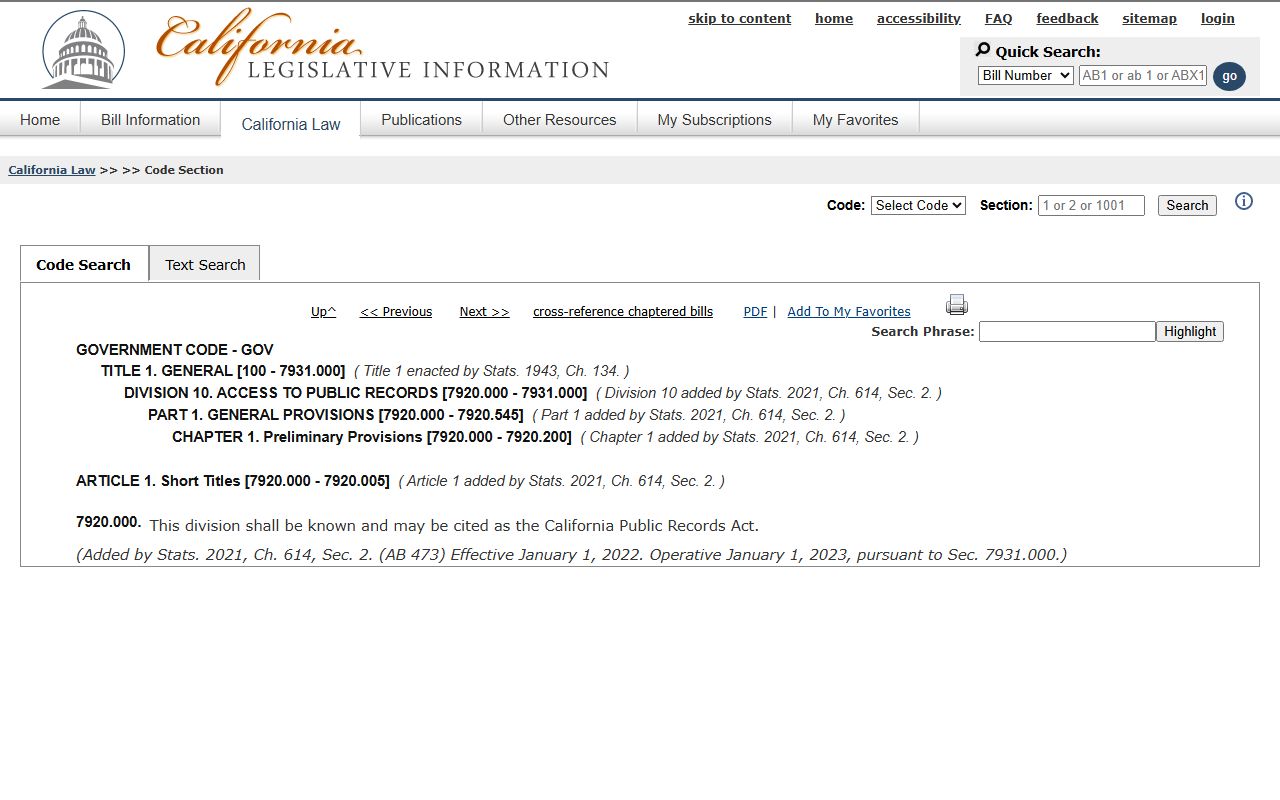
The CPRA was originally enacted in 1968 and recodified effective 2023; the renumbered sections are now in Government Code Division 10.
Monterey County Sheriff Public Records
Sheriff records are processed through the agency's NextRequest portal. Common Sheriff record categories include incident reports, body-worn camera footage subject to SB 1421 and related laws, use-of-force records, jail policies, and operational data not exempted. Requests go in through a free online account; the office acknowledges receipt and provides records or a denial under the CPRA timeline. Records related to ongoing investigations or personnel are often withheld or redacted under the statute.
Court Administrative Records (Rule 10.500)
The Superior Court's case files are not covered by the CPRA. Court administrative records (budget, contracts, personnel policies, statistics, and other non-adjudicative agency files) follow California Rule of Court 10.500. The Monterey court runs requests through the Public Information Office at the Salinas Courthouse and provides a standard administrative records request form. The copy fee is $0.10 per page, paid in advance. The form is not mandatory; a plain written request that describes the record clearly is acceptable.
| Field Label | Type | Required | Notes |
|---|---|---|---|
| Date | Text / date | Unspecified | Request date. |
| Requestor | Text | Unspecified | Name of requester. |
| Mailing Address, City, State | Text | Unspecified | Return address for response. |
| Phone | Text | Unspecified | Voice contact. |
| Text | Unspecified | Email contact. | |
| Document(s) Requested | Multiline text | Yes | Describe records; if name unknown, give date range, topics, or items of interest. |
Send the form or letter to Public Information Office, Superior Court of California, County of Monterey, 240 Church Street, Salinas, CA 93901; phone (831) 775-5400 x3020; fax (831) 775-5499; mediainfo@monterey.courts.ca.gov. PIO hours are 8:00 a.m.-4:00 p.m., Monday-Friday except court holidays.
County Clerk-Recorder Public Records
The Monterey County Assessor-County Clerk-Recorder holds recorded real-property documents, birth, death, and marriage certificates, fictitious business names, statements of partnership withdrawal, DD-214 copies, and related recorded files. The office is at 168 W. Alisal Street, 1st Floor, Salinas. The elected official is Xochitl Marina Camacho. Recording questions go to (831) 755-5041; toll-free from the Monterey Peninsula at (831) 647-7741. The office is the official county repository for property history and ownership research and cannot give legal advice or prepare legal documents.
For marriage records and divorce records, see the marriage and divorce records page.
How to File a Monterey County Public Records Request
The exact path depends on which agency holds the record. The general flow below works for Sheriff records, court administrative records, and county-department records.
- Identify which agency holds the record (Sheriff, court PIO, county department, Clerk-Recorder).
- Describe the record clearly: subject, date range, type, and any case or incident number.
- Submit through the right channel: NextRequest for the Sheriff, PIO at the court, the relevant county department, or the Clerk-Recorder office.
- Include contact information and a way to receive the records.
- Wait for the agency response under the CPRA timeline (generally 10 days to determine, with extensions allowed).
- Pay any copy fees in advance when the agency provides an estimate.
- If denied, ask for the statutory basis in writing.
- To challenge a denial, file a petition in Superior Court under Government Code 7923.000 et seq.
Public Record Fees in Monterey County
The CPRA generally allows agencies to charge direct duplication costs. The court's administrative records form sets the copy fee at $0.10 per page, paid in advance. Sheriff records that require redaction may take longer because of the review needed. The Clerk-Recorder fee schedule lists charges for clerk photocopying, certified copies, FBN filings, and recording.
| Item | Amount |
|---|---|
| Court administrative record copy | $0.10 per page |
| Clerk photocopy under GC 26831 | $2.00 per page or fraction |
| Certificate to official capacity (notary) | $15.00 per signature |
| Fictitious business name (with one certified copy) | $50.00 |
| Statement of abandonment of FBN | $40.00 |
| Marriage certified copy (Clerk-Recorder) | $19.00 (effective Jan. 1, 2026) |
| Standard recording fee | $23 per title (effective Mar. 3, 2026) |
Records That Are Restricted in Monterey County
Some records are not public. Personnel files of police officers are largely confidential except for the limited categories opened by SB 1421 and SB 16. Ongoing investigations can be withheld. Records that would invade privacy can be withheld or redacted. Records covered by attorney-client privilege or attorney work product are exempt. The court records page identifies juvenile, adoption, sealed civil, and confidential marriage files as restricted; see the court records page for more on case-file confidentiality.
State and federal law also creates a layered protection for criminal-history records. The California Department of Justice runs the state's criminal history system; full criminal histories are not public records. Background checks under the federal Fair Credit Reporting Act follow a separate framework.
Historical Court and Government Records
The Superior Court runs a non-confidential historical-records arrangement with the Monterey County Historical Society at 333 Boronda Road, Salinas, CA 93907, (831) 757-8085. The Society holds certain non-confidential historical court records and makes them reasonably available during business hours. The County Clerk-Recorder is the official repository for older recorded property documents. Old fictitious business name filings are retained according to statute.
SB 1421 and Officer Records
California Senate Bill 1421 (2018) and Senate Bill 16 (2021) opened certain peace-officer personnel records that were previously confidential. Records made public under these laws include sustained findings of officer dishonesty, sexual assault by an officer, use-of-force incidents involving death or great bodily injury, and sustained findings of officer-involved discriminatory or prejudicial conduct. The Monterey County Sheriff routes SB 1421 requests through the NextRequest portal.
The Sheriff About page says the office will, upon request of the jurisdictional law-enforcement agency, investigate and independently review officer-involved shootings that result in injury or death and other uses of force resulting in death while in custody or under law-enforcement control. SB 1421 records and SB 16 records are typically released in batches because each record requires careful redaction of third-party privacy details.
Common CPRA Exemptions Applied in Monterey County
Agencies routinely apply a small set of CPRA exemptions when denying a request. Knowing the most common categories helps requesters narrow the request or appeal a denial.
- Investigative privilege — records of ongoing investigations may be withheld while the investigation is active.
- Personnel privacy — personnel files are largely confidential except for the SB 1421 and SB 16 categories.
- Deliberative process — predecisional drafts and internal deliberations may be withheld.
- Attorney-client and work product — agency legal advice is exempt.
- Public-interest balancing — Government Code 7922.000 catch-all for cases where nondisclosure clearly outweighs disclosure.
- Statutory exemptions by code — for example, juvenile records under WIC 827, adoption records under Family Code 9200.
Challenging a Denial
A denied request can be challenged by petition in Superior Court under Government Code 7923.000 et seq. The petitioner asks for a court order requiring disclosure. Costs and attorney fees may be awarded to a successful petitioner. Common denial reasons include investigative privilege, deliberative process, privacy, attorney-client privilege, and the balancing exemption at Government Code 7922.000. The court reviews the asserted exemption against the record at issue.
Note: Court case files use a different framework from CPRA; for sealed civil files, file a motion to unseal under California Rules of Court 2.550 and 2.551.
CPRA Response Times in Monterey County
The CPRA sets a general 10-day determination period after a request comes in. The agency must respond, identify any records to be produced, and state any exemptions claimed. Government Code 7922.535 allows a 14-day extension for unusual circumstances such as a need to search field offices, a high volume of separate records, or consultation with another agency. Total response time can range from a few days for narrow requests to several months for SB 1421 batches or other complex disclosures.
The Sheriff's NextRequest portal time-stamps each request and lets requesters track status in their account. The court PIO handles administrative records under Rule 10.500 on a similar timeline, with the $0.10-per-page copy fee paid in advance. Requests for records the agency does not maintain are returned with that explanation; CPRA does not require creation of new records.