
What a Monterey County Court Docket Shows
A court docket is the schedule of court business for a given day or case. In a single case, the docket is also called the register of actions. It lists every filing, motion, order, and minute entry in order. In a daily-calendar sense, it lists every case set for a department on a given date. The Monterey public portal calls these the Final Daily Calendars. The court publishes them so parties, lawyers, and the public can find a hearing without calling the clerk.
Each docket entry pairs a case with a procedural event. For example: arraignment, pretrial conference, motion to suppress, sentencing, custody review, status conference. The hearing type tells you the purpose. Custody type tells you whether the defendant is in jail at the time of the hearing.
| Calendar Field | What It Shows |
|---|---|
| Hearing Date | The date the matter is set for court. |
| Hearing Time | Time the calendar starts; the clerk calls cases in order. |
| Case Name | Caption (People v. defendant or party v. party). |
| Custody Type | Whether a criminal defendant is in custody. |
| Case Number | Identifier for the case. |
| Department | Numbered department (1-21) hearing the case. |
| Judicial Officer | Assigned judge or commissioner. |
| Hearing Type | Arraignment, motion, trial, status, sentencing, etc. |
How to Find a Monterey County Court Docket
The Final Daily Calendar route on the Monterey Superior Court portal is the main public source. The route lets you filter table results, pick a date, and copy visible table data. The portal also exposes Probate Notes and Tentative Rulings on separate routes.
- Open the portal and click Calendars.
- Select Final Daily Calendars.
- Pick the hearing date from the date picker.
- Type a name or case number in the Filter Table Results box to narrow the view.
- Click Copy Visible Table Data to save the day's calendar.
- For probate, open the Probate Notes route and search by case number.
- For tentative rulings, open the Tentative Rulings route and search by hearing date.
If a hearing is on the calendar but the case is unfamiliar, click through to the case view from the Case Information route. For full Monterey County court records search, see the court records page.
Which Monterey Courts Publish Dockets
Each court site publishes calendars for its assigned departments. Salinas runs Departments 1-11 and Juvenile Department 12. Monterey runs Departments 13-17 plus 13A. Marina runs Departments 20-21. King City runs Department 18 on Tuesdays. The 2026 judicial assignments page lists every department, judge, and case-type assignment.
| Courthouse | Departments | Primary Calendars |
|---|---|---|
| Salinas | 1-11 | Felony, misdemeanor, juvenile dependency, treatment court, criminal mental health. |
| Juvenile Justice (Natividad) | 12 | Juvenile justice, truancy. |
| Monterey | 13, 13A, 14-17 | Probate, CARE Court, civil, family, complex civil, mental-health writs. |
| King City | 18 | Traffic (2nd Tuesday); DCSS/child support (3rd Wednesday every other month). |
| Marina | 20-21 | Traffic, small claims, child support, domestic violence and civil harassment restraining orders. |
Family law cases ending in an odd number go to Department 16. Even numbers go to Department 17. Domestic violence and civil harassment restraining orders also appear in Department 16A one day per week. See the Monterey County Superior Court page for the full department table.
Monterey County Probate Notes and Tentative Rulings
Probate notes are short pre-hearing comments from the probate clerk on a probate filing. The clerk flags missing items, raises questions, or suggests revisions. The probate notes route on the portal lets the public read those notes by case number, which is unusually transparent for a county-level court. Probate hears matters in Department 13 on Wednesdays at the Monterey Courthouse before Hon. Elisabeth K. Mineta.
Tentative rulings are the court's draft decisions on motions before hearing. The portal route is searchable by hearing date and lists Hearing Date, Judge, Department, Caption, Case Number, and Document. Civil departments use tentative rulings often. Parties who do not contest the tentative may not need to appear, depending on local rules. The probate clerk lists a separate route; see probate records for filing detail.
Below is the official probate notes route, one of the most useful pre-hearing tools the court offers.
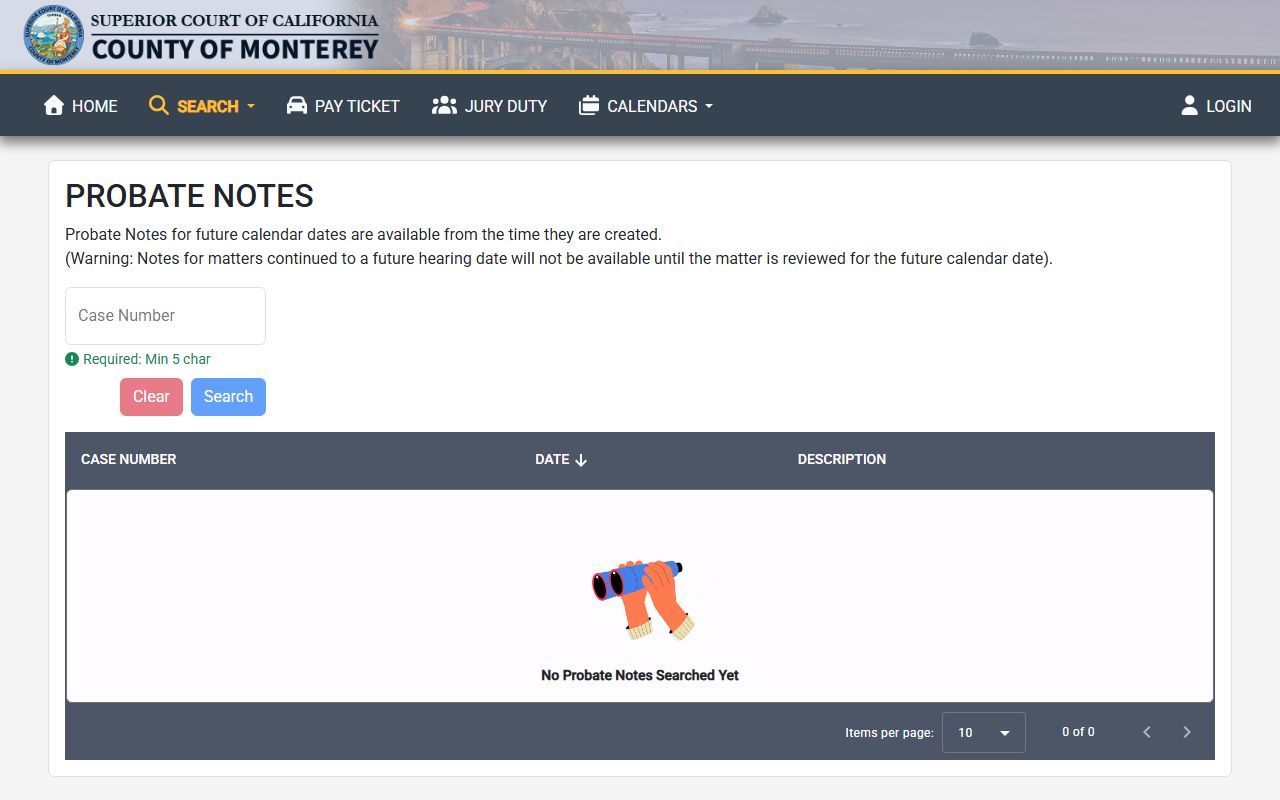
The probate notes route is searchable by case number and displays case number, date, and description fields. Tentative rulings can change after argument; always check the final order in the case file after the hearing.
Appellate Division Calendars
The Superior Court's own Appellate Division hears appeals from limited civil, misdemeanor, and infraction cases. The 2026 assignments list Hon. Pamela L. Butler as presiding judge of the Appellate Division, with Hon. Andrew G. Liu, Hon. Jennifer O'Keefe, and Hon. Mark E. Hood serving. Appellate Division calendars are published with the other Salinas calendars. Larger appeals from Monterey go to the Sixth District Court of Appeal in San Jose, which publishes its own oral-argument calendars on the California Courts site.
How Often to Check Monterey County Dockets
Daily calendars update each business day. Tentative rulings post the day before or the morning of the hearing, depending on the department. Probate notes post about a week before the probate calendar. Final daily calendars include changes from late-added matters, custody status updates, and continuances. Defense lawyers and parties to civil motions check the morning of and again right before the calendar starts.
Hearings can move with little notice. The portal lists "Continued" or moves the case to a new date when that happens. Parties get formal notice in their case file. For a status check between hearings, click into the case view and read the register of actions; it is often more current than the daily calendar.
Criminal Calendars and Custody Type
Criminal calendars at Salinas use the custody-type column to flag whether each defendant is in jail at the time of the hearing. The criminal arraignment calendar in Department 11 runs daily for new misdemeanor cases. Felony arraignments run in Department 1 before Hon. Stephanie E. Hulsey. Pretrial conferences, motions, and trials run in the felony trial departments 2-6 and the misdemeanor trial departments 7-9, with assigned letter-of-the-alphabet ranges so that each judge consistently hears the same defendants throughout the case.
The Combined Drug Court, DUI Treatment Court, Military Diversion and Veterans Treatment Court, and Criminal Mental Health calendars run in Department 10 before Hon. Timothy Roberts. These treatment-court calendars include review hearings every two to four weeks, with the team meeting before the calendar. Records of these calendars are public, though specific medical or competency content may be limited.
Family Law and Civil Calendars
Family law calendars at the Monterey Courthouse run in Departments 16 and 17. Department 16 takes cases ending in odd numbers; Department 17 takes even numbers. Department 16A runs domestic violence and civil harassment restraining orders one day a week before Commissioner Maria L. Mendoza. Civil calendars run in Departments 13A, 14, and 15. Department 13A runs civil ex parte, fee waivers, labor appeals, and Riese hearings. Departments 14 and 15 run direct calendar civil trials and complex civil.
Small claims at Marina run before Department 20. Small claims appeals are heard in Department 13. The Marina courthouse also runs Department 21 for child support, domestic violence restraining orders, and civil harassment restraining orders. King City's Department 18 runs on Tuesdays only, with traffic on the second Tuesday and DCSS child support on the third Wednesday every other month.
Common Monterey Docket Abbreviations
Docket entries are written in clerk shorthand. Reading a Monterey register of actions gets easier once you know the common abbreviations.
- ARR
- Arraignment.
- PHRG
- Preliminary hearing.
- MOC
- Minute order continued.
- PRTL
- Pretrial conference.
- JT
- Jury trial.
- CT
- Court trial.
- DV
- Domestic violence.
- PV
- Probation violation.
- FTA
- Failure to appear.
- RFO
- Request for order (family law).
- OSC
- Order to show cause.
- OAH
- Off-calendar hearing.
Remote vs Courthouse Calendar Access
California Rule of Court 2.507(b) limits remote electronic access in some case types. Monterey complies by giving remote access to indexes, calendars, and registers of action where permitted. Courthouse computer terminals fall under Rule 2.503 and can show more, including some documents the portal does not display from home. Self-represented parties who need full file access often visit the records counter at Salinas (criminal) or Monterey (civil/family/probate). See the court records page for the full records-counter workflow.
Courthouse Rules During Calendar Call
The Criminal Process page gives practical advice for any docket appearance at Salinas. Plan to arrive early because parking is limited near the courthouse. Allow time for entrance security screening at every public door. Inside, check the central calendar board behind security to find the courtroom. If the case name is not on the board, check with the Clerk's Office. Before court starts, the bailiff announces when the courtroom opens and gives instructions.
Courtroom rules at every Monterey court site include: cell phones must be turned off; food and beverages are not allowed; hats and sunglasses must be removed; chewing gum is not allowed; and participants must keep a professional demeanor and not disrupt the calendar. When a case is called, the party stands, walks forward as the bailiff directs, keeps hands outside pockets, and answers the judge audibly. Attorneys address the judge as "Your Honor." Self-represented parties may do the same. These rules apply to civil, family, probate, and criminal calendars.